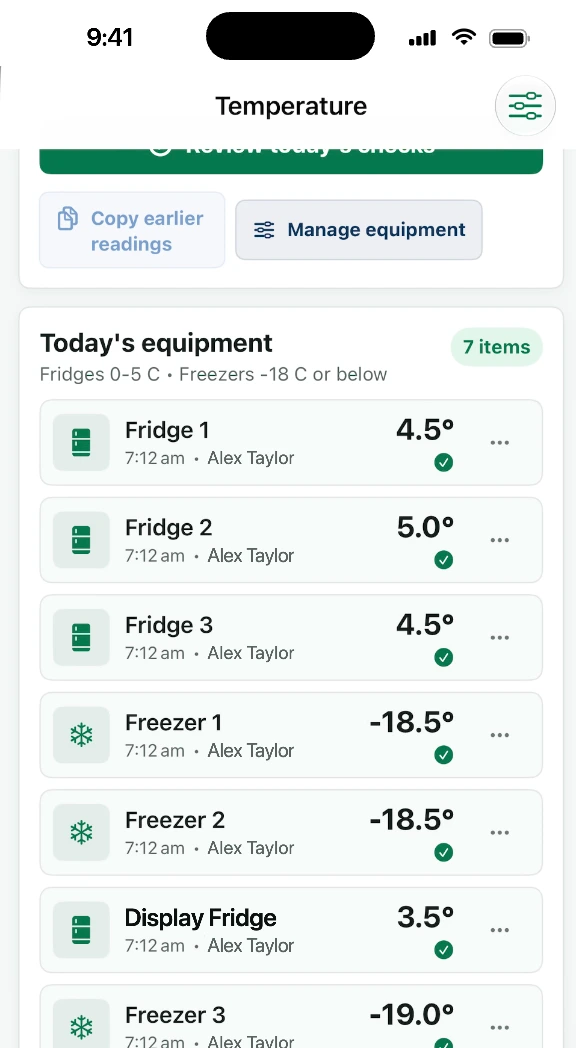
What temperatures should the routine use?
Food Standards Agency guidance says cold food must be kept at 8°C or below in England, Wales and Northern Ireland. In practice, it recommends setting a fridge at 5°C or below so there is room for normal temperature fluctuation.
The FSA's SFBB guidance recommends checking fridges and chilled-display equipment at least once a day, beginning with opening checks. It also explains that a display or dial should be checked periodically against a suitable thermometer because a set temperature is not always the temperature food experiences.
This page does not claim one statutory temperature rule applies identically across every UK nation. Scottish businesses should follow Food Standards Scotland and local-authority guidance.
A strong fridge and freezer log records context
- Appliance: use a stable name such as "Walk-in fridge" rather than a number nobody recognises.
- Date and time: record when the reading was actually taken.
- Temperature: enter the measured figure, including a minus sign for freezer readings.
- Person: keep the responsible initials or account with the result.
- Target: use the range defined by the business's food-safety system and equipment.
- Action: record what was checked, adjusted, moved, discarded or escalated when the result was unexpected.
What to do with an unexpected reading
Do not simply change the figure until it appears acceptable. Confirm whether the reading method and display are reliable, check the food and equipment, protect affected food, and follow the corrective action in the business's documented system. Record the outcome honestly.
If the issue repeats, it may point to an overloaded unit, damaged seal, unsuitable process, display error or equipment fault. Escalate and review the safe method instead of treating every high reading as an isolated event.
Keep the record easy to review
The most useful view separates today's work from complete history. Staff should be able to see which appliance still needs a reading, while a manager can move through dates, find gaps and export evidence without loading thousands of rows at once.