What each rating means
The Food Hygiene Rating Scheme runs in England, Wales and Northern Ireland. After an inspection, the local council gives a rating from 0 to 5:
| Rating | What it means |
|---|---|
| 5 | Hygiene standards are very good |
| 4 | Hygiene standards are good |
| 3 | Hygiene standards are generally satisfactory |
| 2 | Some improvement is necessary |
| 1 | Major improvement is necessary |
| 0 | Urgent improvement is required |
Businesses in Wales and Northern Ireland must display their rating by law. In England, displaying it is voluntary but encouraged, and ratings are published online either way.
Scotland uses a different scheme, the Food Hygiene Information Scheme. Outlets receive a Pass or Improvement Required result rather than a number.
The three things the officer scores
- How hygienically food is handled: preparation, cooking, reheating, cooling and storage, including how raw and ready-to-eat food are kept apart.
- The physical condition of the business: cleanliness, layout, lighting, ventilation, handwashing and other facilities, and pest control.
- How the business manages food safety: whether there is a food-safety management system based on HACCP principles (such as Safer Food, Better Business), whether staff are trained and supervised, and whether the officer can be confident standards will be kept up.
The third area is often called "confidence in management". It is where many businesses lose a rating they could have kept. The kitchen may be clean on the day, but without a working system and records the officer cannot see that it is clean every day.
A practical checklist for a 5
- Have a written food-safety system that fits what you actually cook and sell, and keep it up to date when the menu or equipment changes.
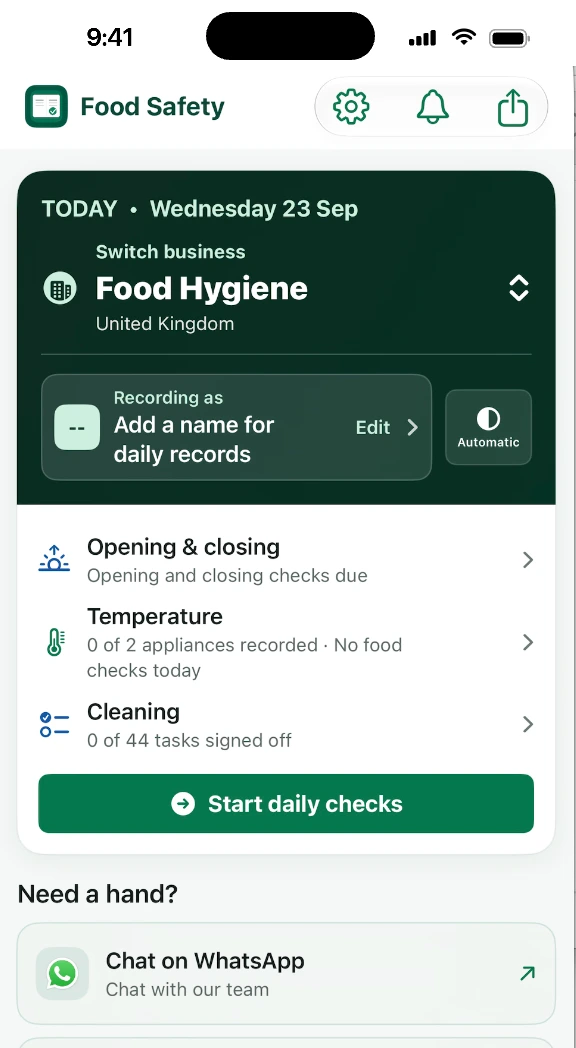
- Record opening and closing checks every day, with the date and who did them.
- Log fridge and freezer temperatures at least once a day, and write down what you did when a reading was wrong.
- Record cooking, cooling and reheating checks for the processes your system says need them.
- Follow a cleaning schedule that says what is cleaned, how, how often and by whom, and mark tasks as done.
- Keep allergen information accurate for everything you sell, and make sure staff know how to answer questions.
- Keep staff training records that match each person's job.
- Record problems and what you did about them: a genuine problem with a clear corrective action shows good management.
- Review regularly: repeated problems should lead to a change, not the same note every week.
Officers are experienced at spotting records written all at once. An honest gap with an explanation is far safer than invented evidence.
If you are not happy with your rating
- Appeal: if you think the rating is wrong, you can appeal to the council. If you appeal within 21 days of receiving the rating, it is not published online until the appeal has been reviewed.
- Right to reply: you can publish a short response next to your rating at any time, for example to explain what you have improved.
- Ask for a re-rating visit: once you have made the improvements, you can ask the council to inspect again. Most councils charge a fee, and the new rating can go up, down or stay the same.
In Scotland, a business with an Improvement Required result can ask for a re-visit at any time after making the improvements.