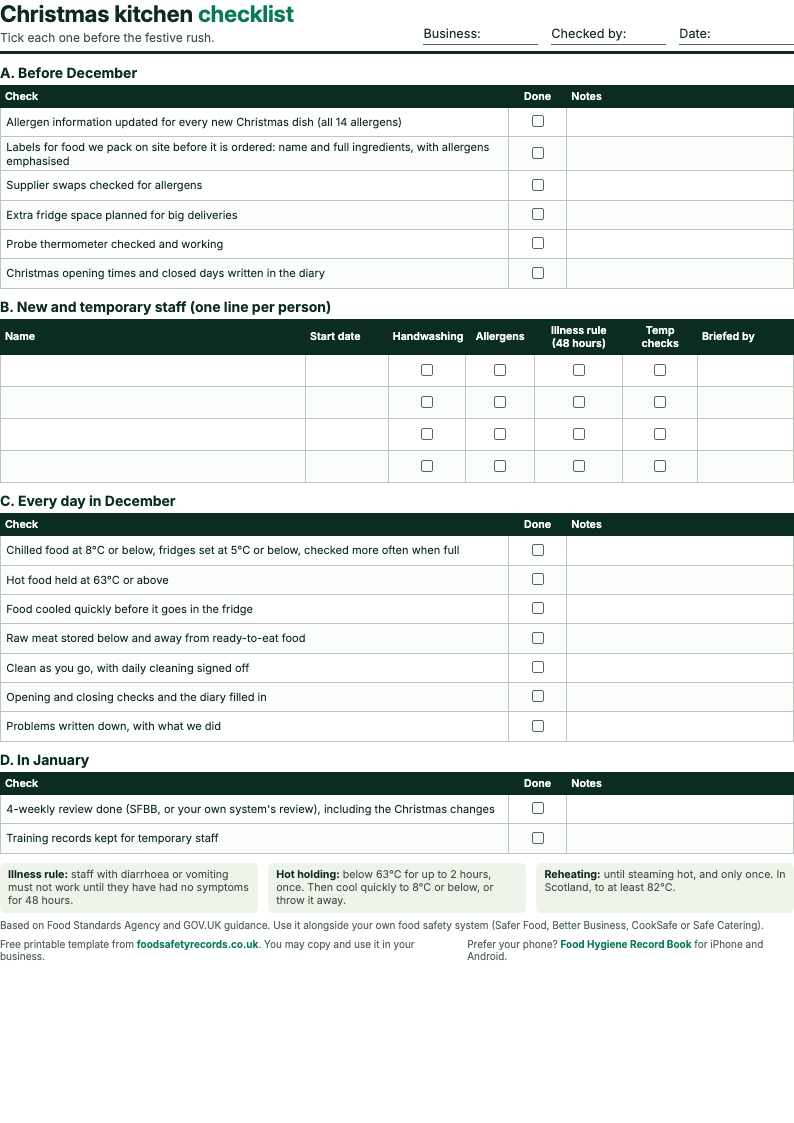
Why Christmas is different
A festive menu changes almost everything at once: new dishes and new suppliers, bigger orders, extra staff who don't know your kitchen, fridges full of stock, and longer hours.
None of the food safety rules change at Christmas. What changes is how easy it is to forget them. Your food safety system (Safer Food, Better Business in England and Wales, CookSafe in Scotland, or Safe Catering in Northern Ireland) already covers every point below. This checklist helps you apply it to December.
1. Allergens on your Christmas menu
New festive dishes need allergen information before they go on sale.
- Check each new dish against the 14 allergens. Include sauces, stuffing, gravy, toppings and anything you buy in ready-made.
- Christmas puddings, Christmas cakes and mince pies often contain several allergens, such as cereals containing gluten, eggs, milk, nuts and sulphites (often in dried fruit). Read the label or the recipe for your product, and never guess.
- Food you pack on site before the customer orders (for example, wrapped mince pies or sandwiches in the chiller) is "prepacked for direct sale". Its label must show the name of the food and a full ingredients list, with any of the 14 allergens emphasised.
- Tell your team where the allergen information is kept. Temporary staff must know to ask, not guess.
- Keep it accurate if a supplier swaps a product because something is out of stock.
2. Temporary and seasonal staff
- Before their first shift, show every new person handwashing, your allergen information, your temperature checks, and who to ask.
- The illness rule: staff with diarrhoea or vomiting must not return to work until they have had no symptoms for 48 hours. Tell new staff this on day one.
- Training: you must be able to show that your staff have the right skills and training for their role, so supervise new people until they know your safe methods.
- Write it down: add each new person to your training record, including the short briefing.
3. Fridge space and deliveries
- Plan bigger deliveries for when you have fridge space. Don't cram fridges: cold air needs room to move.
- Check chilled deliveries are cold and frozen deliveries are frozen hard. Refuse anything that isn't, and write down what you did.
- Check fridge temperatures more often while fridges are full and the doors keep opening. Chilled food must be kept at 8°C or below. This is the law in England, Wales and Northern Ireland, and recommended in Scotland. Set fridges at 5°C or below so food stays cold enough even when the temperature changes.
- Defrost frozen food in the fridge, and allow plenty of time: a large joint can take much longer than you expect. Food must be fully defrosted before cooking, unless the instructions say to cook it from frozen.
- Keep raw meat below and away from ready-to-eat food.
4. Cooking, cooling and reheating
- Cook food until it's steaming hot all the way through. Check the thickest part with a clean probe, as your safe method says.
- Cool food as quickly as possible, then put it in the fridge. Split it into smaller portions, spread it out on trays, or stand covered pans in cold water. Don't leave big pots to cool slowly on the side.
- Hot holding: hot food you're not serving straight away must be kept at 63°C or above. You can keep it below 63°C for up to 2 hours, once. After that, cool it as quickly as possible to 8°C or below, or throw it away.
- Reheating: reheat food until it's steaming hot all the way through, and only reheat it once. In Scotland, reheated food must reach at least 82°C.
5. Cleaning when you're at your busiest
- Clean as you go, especially boards, knives and probes between raw and ready-to-eat food.
- Keep the daily and weekly cleaning tasks, even on late nights, and write down what was done.
- Check for pests where extra stock is stored, for example boxes on the floor or a back room.
6. Keep your records going
Records are what show an inspector that your system works, and the busiest weeks are when gaps appear.
- Fill in your daily diary and your opening and closing checks every day you're open.
- Mark the days you're closed (for example, Christmas Day), so gaps don't look like missed checks.
- Write down any problems and what you did, such as a fridge running warm or a refused delivery.
- Do your 4-weekly review in early January, and note any changes you made for Christmas.
7. Christmas markets and pop-ups
If you're trading somewhere new, such as a Christmas market or a pop-up stall, ask the organiser and the local council what you need. You'll still need handwashing, temperature control and allergen information on the stall.
A 5-minute Christmas staff quiz
Use it at a team briefing. The answers are underneath.
- A customer asks if the Christmas pudding contains nuts. What do you do?
- A new team member was sick last night but feels fine now. Can they work today?
- What's the highest temperature chilled food should be kept at?
- What temperature should hot-held food be kept at?
- A big pan of gravy needs to go in the fridge. What should you do first?
1. Check the allergen information or ask the manager. Never guess. 2. No. They must not return to work until they have had no symptoms for 48 hours. 3. 8°C or below, with fridges set at 5°C or below. 4. 63°C or above. 5. Cool it quickly first, for example by splitting it into smaller containers, then put it in the fridge.
- GOV.UK: Chilling and freezing food
- GOV.UK: Cooking food (hot holding and reheating)
- GOV.UK: Staff training, illness and hygiene
- GOV.UK: Labelling guidance for prepacked for direct sale (PPDS) food
- The Food Hygiene (Scotland) Regulations 2006, Schedule 4 (reheating to 82°C)
Checked 23 October 2026. This guide is general information: follow your own food safety management system, and ask your local council's food team if you're not sure.